
About the project
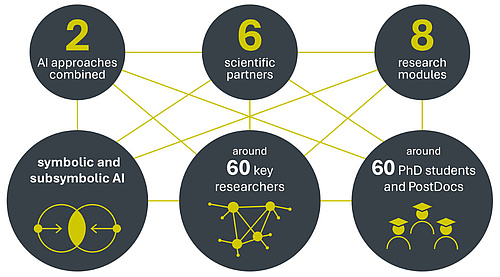
The project “Bilateral AI” aims at lifting artificial intelligence (AI) to the next level. Current AI systems are unreliable, opaque, and data- and energy inefficient. Furthermore, in many tasks they lack human common sense and the broad generalization capabilities of humans. Our project will combine two of the most important types of AI which have mostly been developed separately so far: symbolic and sub-symbolic AI. While symbolic AI works with clearly defined logical rules, sub-symbolic AI is based on training a machine with the help of large datasets to create intelligent behavior. This integration, resulting in a Broad AI, is intended to mirror something that humans do naturally: the simultaneous use of cognition and reasoning skills.
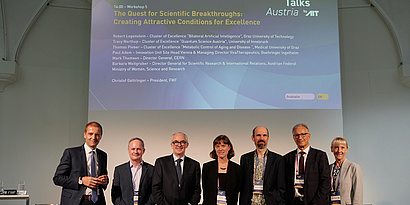
BilAI at the Technology Talks Austria 2026
This autumn’s Technology Talks Austria focused on “Empowering Europe: Technological Leadership for a Resilient Future”, with BilAI Board Member Robert Legenstein among the experts discussing the future of research and technology in Europe.
Read more
BilAI Summer School 2026 at ESSAI: Connecting with Europe's AI Community
Bringing together the BilAI community with Europe's largest broad AI summer school, this year's edition offered an exceptional environment for learning, interdisciplinary exchange, and international networking.
Read more
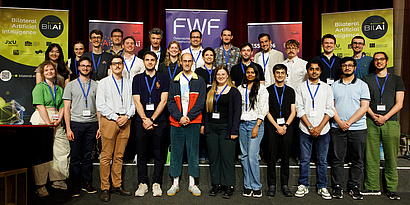
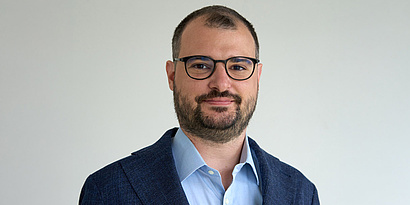
BilAI Key Researcher Francesco Locatello receives an ERC Starting grant
BilAI Key Researcher Francesco Locatello has been awarded an ERC Starting Grant for his Causal-AIM project, which aims to develop AI models capable of detecting and quantifying causality in scientific experiments across different types of data.
Read more
Partners